




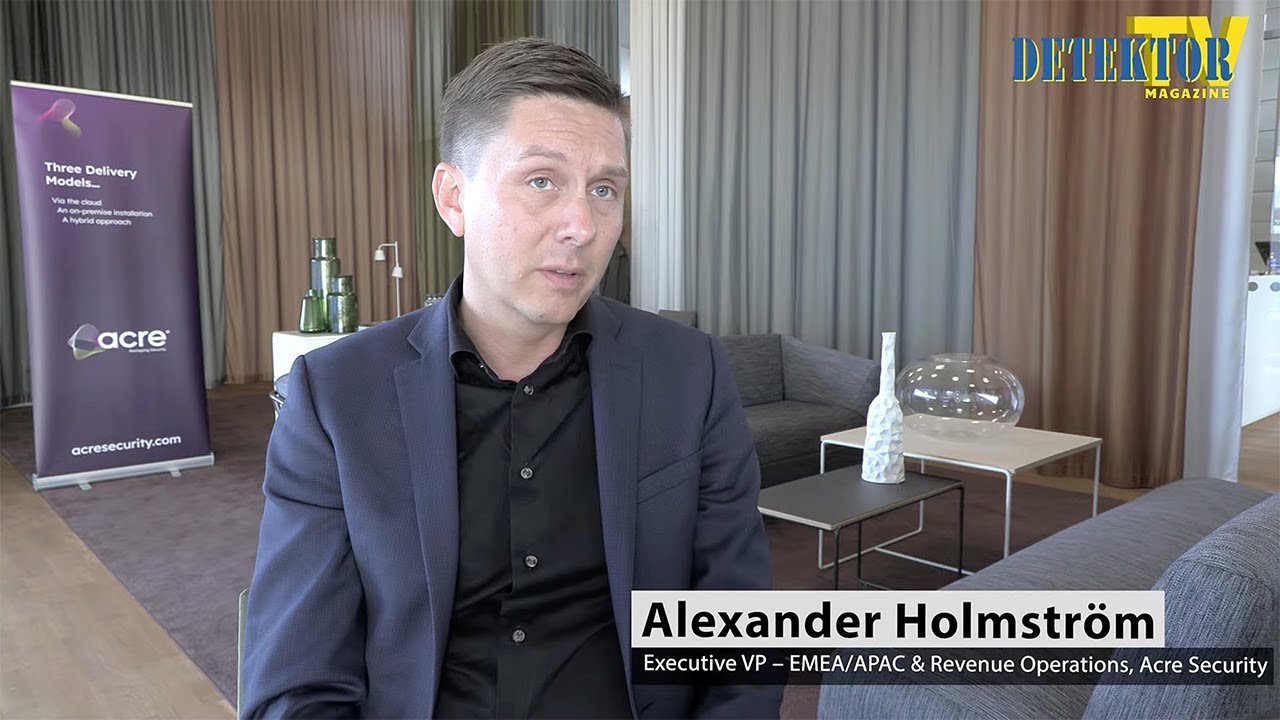
AAC (Acre Access Control) is a cloud-based physical security platform and Acre’s primary access control system. Acre Via was launched at ISC West in Las Vegas; it is an AI assistant integrated into AAC that helps manage and monitor the access control system. This product launch serves as the starting point for this interview with Alex Holmström.
What is the major benefit of Acre Via?
“I would say that Acre Via and generative AI add a whole new dimension to access control by shifting from traditional reports and usage patterns to a dialogue-based interaction,” says Alex Holmström.
“Instead of manually clicking through menus, you can type questions to the AI assistant and get help with troubleshooting, analysis, or generating reports,” he adds.
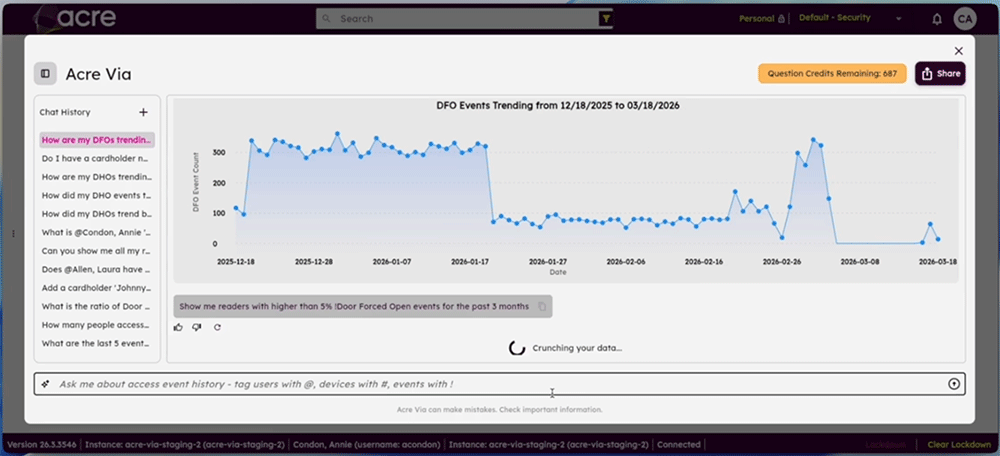
Which AI applications are creating most value for end customers?
“The benefits for the end customer can be summarised in three parts: more proactive and data-driven security, automated administration, and better workplace analytics. There are several measurable benefits in the form of lower total costs and increased efficiency.”
Why has the adoption of AI in access control systems taken so long?
“The development of AI and cloud-based access systems has likely been partially slowed down by local regulations in various countries. However, various technical challenges related to data management have also hindered progress. Large amounts of data and significant processing power are required – especially when combined with AI – to generate insights such as predictive analytics.”
“The need to handle sensitive data in compliance with data protection regulations and meet privacy requirements is another factor.”
Has cost also been a factor?
“Yes, integration and cost issues have played a role, as replacing traditional on-prem solutions – whether IP-based, mechanical, or analogue systems – represented a major investment. But now it is more accessible and cost-effective, and there is also the option to retain parts of the existing hardware infrastructure while gradually migrating to the cloud and fully leveraging AI.”
How do you define the benefits of AI in an access control system – what concrete problems does AI help customers solve?
“You could say that Via is an intelligent AI layer capable of processing vast amounts of real-time data to easily solve problems – such as system administration, where everyday language can be used to create users and configure the system.”
Could you be more specific about the benefits?
“You can save time and easily generate reports instead of manually searching through logs. The AI assistant makes it quick to investigate and detect anomalies, such as unauthorised individuals or unusual activities. You get a proactive security system that gives the user complete oversight of all identities and users around the clock.”
How, specifically, can the AI assistant contribute to enhanced security?

“Access rights issues can be quickly identified, as can repeated door alarms, making it easier for the operator to rapidly make sound decisions regarding appropriate actions.
“The AI assistant also simplifies the performance of administrative tasks for operators, such as creating new users.”
Isn’t there a risk that the AI might produce incorrect answers, leading to no action being taken or to irrelevant decisions?
“We have guardrails in place. These are safety mechanisms ensuring that the AI cannot make any changes to the system on its own; instead, it simply presents information and suggests possible actions that always require human approval.”
”For example, an operator can ask how the door units have triggered alarms or been used over the past week and receive a clear report visualising this data. This enhances security and offers opportunities to optimise the system.”
How does gen AI impact operational efficiency – which organisational tasks can be automated or simplified?
“Generative AI definitely boosts operational efficiency by transforming complex data flows, enabling organisations to simplify and automate system administration for cardholders and access rights, as well as to carry out more efficient maintenance, servicing, and hardware checks.”
How can AI help reduce energy consumption, optimise staffing, or otherwise make security operations more sustainable?
“Smart environmental thinking is crucial in modern security operations; AI can contribute by significantly reducing energy consumption through smarter control of facilities and processes, as well as by optimising staffing via predictive scheduling. There are numerous synergies to be gained from implementing an AI and cloud-based security system when it is integrated with other building automation systems.”
What savings or business benefits do you see customers achieving by using AI features like Acre Via?
“Several studies show that the progressive use of AI tools alone can lead to time and cost savings of over 20 percent. As a tool, Via gives users faster access to accurate information –eliminating the need to build solutions manually – and saves many hours of administrative time. It also creates a higher overall level of security when combined with cloud-based security systems.”
Why are you launching Acre Via right now?
“We acquired the company Reks in January of last year, and our R&D team has been actively working on integrating this purpose-built AI function with Acre Access Control.”
And how has the market reacted?
“The market has reacted very positively, and following the international launch in Istanbul in April, we have received very positive feedback from our partners in Europe and North America. A great many end customers have also confirmed that this will significantly facilitate daily operations.”
Do you think unified platforms and AI assistants will become the primary interface between the user and the security system?
“From an interface perspective, there is definitely a demand for unified solutions and ease of use.”
“Interestingly, over the past ten years, we have moved from unified proprietary solutions to open architecture. The market wants unified, open solutions with user-friendly interfaces that allow for integration with various market-leading third-party solutions to create a strong, comprehensive system.”
“In this context, the development and secure use of AI will play a major role in the connected systems of the future.”
How are integrators – the ones delivering the systems – affected by the growing demand for AI assistance?
“Initially, they will need to drive a strong service model that combines the technology with services in their offering. They will also need an organisation capable of supporting the end customer on their journey.”
And what does that mean?
“That they must be able to manage current hardware and software while gradually migrating solutions to future reader technology and AI applications, as well as provide future-proof hardware offering the right performance, smarter video analytics, and visitor management solutions – combined with intrusion alarms and access control systems.”
“It follows that they must, of course, listen to the end customer and build a solid foundation for the solutions needed to meet future requirements.”



 Global