



The modern workplace is no longer limited to a desk, a building entrance or a single way of working. Employees increasingly move between physical spaces and digital environments throughout the day, using technology to access offices, collaborate with colleagues and connect with workplace services.
According to Nicolas Raffin, this development means organisations need to rethink the role of identity – and particularly the role of mobile credentials.
“A mobile credential is no longer just a digital replacement for an employee badge. Its true potential comes from its ability to connect people with the many systems and spaces they interact with every day,” he says.
From entering a building and accessing a workstation to releasing documents from secure printers, opening smart lockers or reserving meeting spaces, the same credential can potentially follow an employee throughout the working day. But creating such a connected experience requires more than simply adding an employee badge to a smartphone wallet.
“The underlying infrastructure must enable the credential to work across the wider workplace ecosystem,” explains Raffin.
Beyond the front door
Traditionally, employee badges have primarily been used to grant access to buildings or restricted areas. That has not changed. The entrance is where most organisations first deploy mobile credentials, and it is increasingly where the security case is made. So physical access remains important, but Raffin argues that hybrid working and flexible office environments are creating new requirements.
“Employees may no longer have assigned desks, teams can work across several locations, and workplace services are becoming increasingly digital. This creates more situations in which an employee’s identity needs to be verified,” he says.
“A truly connected workplace requires a credential that can move with employees throughout their day.”
One credential, many uses
Raffin explains that an employee could, for example, arrive at the office and use a smartphone to enter the building. Once inside, the same credential could authenticate the employee at a computer, release a confidential document from a printer, unlock a personal storage locker or check in to a pre-booked desk.
“Instead of using a combination of apps, cards, QR codes, PINs and physical keys, organisations can provide these functions through a single mobile identity. This changes the credential from a simple access tool into a connection point between employees and the workplace,” he explains.
More than “tap to enter”
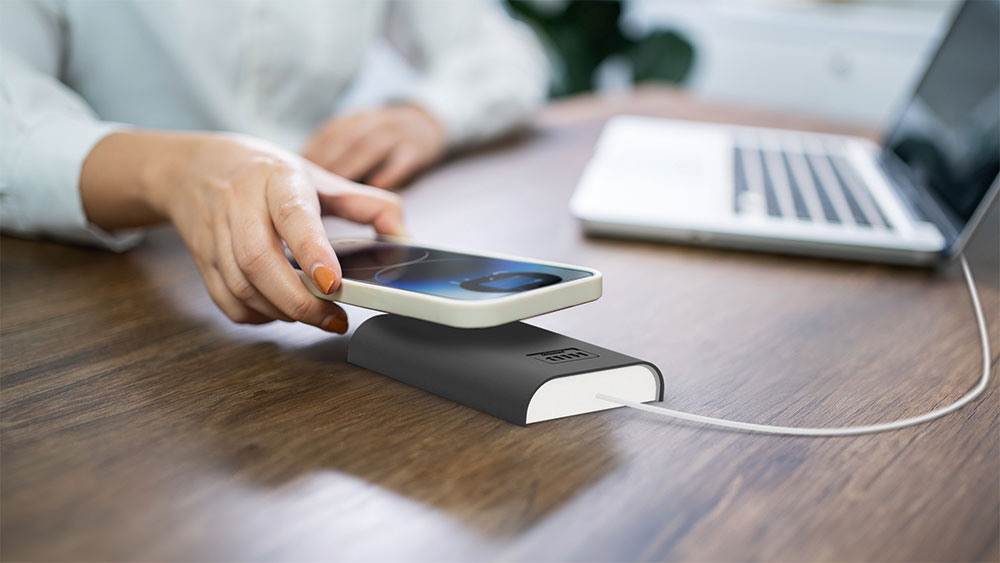
Mobile credentials are still strongly associated with tapping a smartphone at a door reader. Raffin believes this represents only one part of their potential.
“The real opportunity lies in expanding the credential across the workplace,” he says, pointing to secure printing as one example.
“Employees traditionally authenticate themselves at printers using passwords, PINs or physical cards. A mobile credential can instead use the same identity already employed for other workplace interactions.”
Raffin further explains that this can also improve document security by ensuring that sensitive documents are released only when the authorised employee is physically present at the printer. It can also reduce unnecessary printing.
Printers and lockers
Smart lockers are another application. As flexible working becomes more common, employees increasingly need temporary or flexible storage rather than permanently assigned facilities. Mobile credentials can provide access without requiring another key, card or authentication method.
The same principle can be extended to meeting-room systems, visitor management, kiosks and time-and-attendance solutions.
“With a single mobile credential, accessing these services can be as simple as tapping a phone,” says Raffin.
The result, he argues, is a more unified workplace experience in which employees spend less time navigating different systems.
Infrastructure is key

Making a mobile identity work across all these applications requires an infrastructure capable of connecting the credential with different devices and workplace systems.
“This is where reader infrastructure plays a key role,” says Raffin.
Desktop readers, embedded modules and other mobile-ready technologies can extend mobile credentials beyond conventional physical access points. They effectively provide the connection between an employee’s digital identity and systems that require secure authentication.
From digital badge to identity platform
For Raffin, the objective therefore goes beyond simply digitising the traditional employee badge.
“The goal is not simply to digitise an existing badge experience. It is to create a foundation that allows organisations to continue expanding how and where identity is used,” he says.
A flexible reader ecosystem can also make it easier for organisations to introduce new workplace technologies without creating additional disconnected solutions.
A familiar experience
Raffin also emphasises the advantage that mobile credentials offer, namely that they fit naturally into existing user behaviour. Employees already carry smartphones and use them for payments, communication, account access and numerous other everyday activities.
“Using the same device for workplace identity can therefore remove several points of friction. Employees no longer need to carry multiple access cards or authentication devices, or learn different processes for individual workplace services,” he states.
Convenience and security
At the same time, mobile credentials can give organisations greater control over identity management. They can support secure authentication, centralised credential management and remote provisioning. New employees can receive credentials without waiting for a physical badge, while access rights can be changed or removed remotely when an employee changes role or leaves the organisation.
“This combination of convenience and security helps organisations create workplace experiences that are both user-friendly and resilient,” says Raffin.
Identity as a foundation
As workplaces continue to evolve, Raffin expects employee expectations and workplace technologies to change with them. In his view, organisations therefore need to think of identity as something broader than a mechanism for controlling access.
“The organisations that succeed will be those that view identity as more than a way to control access. They will see it as a foundation for creating better workplace experiences,” he says.
One identity everywhere
Mobile credentials can provide a bridge between physical and digital environments, allowing organisations to extend a single identity across a growing range of workplace services.
“The future of workplace access is not about replacing one badge with one smartphone. It is about creating a single identity that works everywhere employees need it to – across entrances, devices, services and experiences,” says Raffin.
One example of how HID is putting this concept into practice is through its Omnikey technology. By enabling mobile credentials to be used across readers, partner devices and workplace applications, the technology is designed to extend mobile identity beyond conventional access control.
“Mobile-ready readers and modules can be embedded into different devices, providing an interoperable infrastructure designed to support secure, seamless and scalable workplace journeys,” concludes Raffin.




 Global