




The global access control market continues to expand as organisations invest in more flexible, connected and intelligent security solutions. According to Grand View Research, the global market was valued at approximately USD 11.6 billion in 2025 and is expected to reach 12.5 billion dollars in 2026. By 2033, it is forecast to reach 22.8 billion dollars, representing a compound annual growth rate of 9 per cent between 2026 and 2033.
Memoori provides another perspective, estimating the global physical access control market at 15.8 billion dollars in 2025, rising to 16.7 billion dollars in 2026 and reaching 21.3 billion dollars by 2030, representing a CAGR of 5.94 percent (2024-2030).
The figures are not directly comparable. Grand View Research measures the market at end-user value and includes hardware, software and services such as installation, integration and maintenance. Memoori uses manufacturers’ selling prices and a narrower PACS definition focused on hardware, credentials and access control software. Its analysis covers 273 companies worldwide.
Structural transformation
Beyond overall growth, Memoori points to a structural transformation as value increasingly shifts from traditional hardware towards cloud platforms, recurring software revenues and managed services.
This is also changing the fundamental role of access control. James McHale, CEO of Memoori and author of the company’s latest access control market report, sees access control taking on a much broader role in connected buildings.
“Access control is no longer just about keeping people out; it’s about knowing who’s in, where they are, and what services the building should deliver in response,” he says.
Mobile credentials
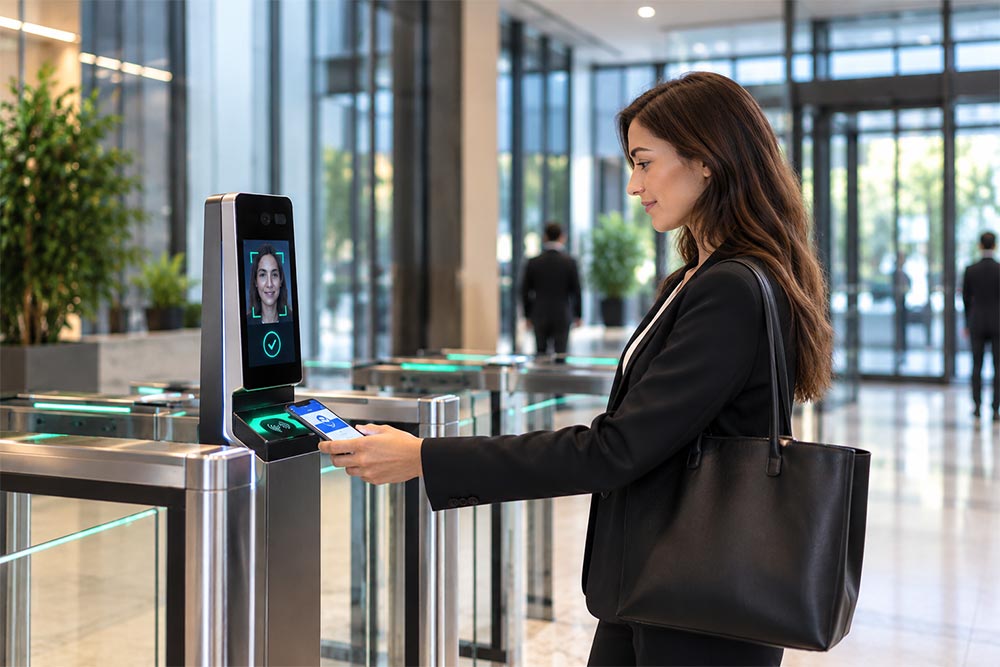
One of the clearest trends is the move from traditional cards and fobs towards mobile credentials. Smartphones and digital wallets can increasingly be used as secure credentials, allowing users to access buildings without carrying a separate physical card.
For organisations, mobile credentials can simplify issuance, administration and revocation, while integration with digital identity platforms enables access rights to follow the user throughout the identity lifecycle.
Wallet-based credentials are also creating stronger links between physical and logical identity management. This development could eventually make the distinction between physical access control and enterprise identity management less pronounced.
Biometric identity
Biometrics is another area seeing rapid development. Facial recognition, fingerprint authentication and other biometric technologies are increasingly being integrated into access control systems.
The attraction is clear: unlike a card or mobile phone, a biometric identifier is directly linked to the individual. Combined with other credentials, biometrics can provide stronger authentication while enabling more frictionless access.
At the same time, privacy, data protection and regulatory requirements remain important considerations, particularly in Europe. Solutions that store biometric templates securely – or allow credentials and templates to remain under the user’s control – are therefore gaining attention.
The development reflects a wider shift towards identity-centric security. As McHale puts it:
“Modern buildings are increasingly identity-driven in their operation.”
Access control is consequently becoming part of a much broader identity infrastructure, connecting employees, visitors and contractors with their roles, permissions and interactions across buildings and digital systems.
Generative AI simplifies
Artificial intelligence is already well established in areas such as video analytics, but generative AI is now beginning to influence access control as well.
One important application is system administration. Instead of navigating complex menus, operators can increasingly interact with security platforms using natural language. They can ask questions, search for information, generate reports or receive assistance in carrying out administrative tasks.
This could significantly reduce the complexity of managing large access control systems. Generative AI can help operators identify relevant information more quickly, analyse events and create reports without requiring detailed knowledge of the underlying system architecture.
As AI develops further, systems are also likely to move from simply providing information towards recommending actions and, under human supervision, executing workflows.
Unified and open platforms

Another major trend is the move towards unified security platforms. Organisations increasingly want access control, video surveillance, intrusion detection, visitor management and identity management to work together rather than operate as separate systems.
Integration with systems outside traditional physical security is becoming equally important. HR platforms, building management systems, workplace applications and enterprise identity platforms all need to exchange information with access control.
This makes open standards and APIs increasingly important. Customers want the flexibility to select technologies from different suppliers and integrate them without becoming locked into a proprietary ecosystem.
McHale sees this as a fundamental architectural shift:
“Rather than operating as isolated silos, these functions are converging around a shared identity layer, with access control providing the real-time presence signal that makes automation possible.”
The demand for openness is also becoming visible in procurement. According to McHale, “a significant number of new enterprise tenders now include API access as a mandatory requirement,” reflecting expectations that access control should integrate seamlessly with HR platforms, identity governance tools and digital workplace services.
Cloud and services
Cloud-based access control continues to gain ground. For end users, the cloud enables centralised administration across multiple sites, remote updates and easier scaling. For installers and service providers, it creates opportunities for recurring revenues through Access Control as a Service (ACaaS).
Hybrid architectures are also important. Not every organisation is ready – or able – to move all security functions to the cloud. Platforms combining local processing and control with cloud-based management and services can provide a migration path between traditional on-premises systems and fully cloud-based solutions.
The move towards subscription-based services is also changing the relationship between manufacturers, integrators and end users. Software, analytics, remote management and cybersecurity services are becoming increasingly important parts of the overall access control offering.
Cybersecurity is key
As access control becomes more connected, cybersecurity becomes increasingly critical. A modern system is no longer an isolated network of readers and controllers. It is connected to cloud services, mobile devices, corporate IT systems and other building technologies. This increases the potential attack surface and places greater demands on encryption, authentication, secure communication, software updates and vulnerability management.
In Europe, regulation is accelerating this development. NIS2 increases cybersecurity requirements for many organisations and their supply chains, while the Cyber Resilience Act introduces cybersecurity requirements for products with digital elements throughout their lifecycle.
For access control manufacturers, cybersecurity is therefore becoming part of product design rather than an additional feature. Integrators and end users will increasingly need to consider not only what a product can do, but how it is maintained, updated and protected throughout its operational life.
Open and intelligent
Taken together, these trends point towards an access control market that is becoming more software-driven, identity-centric and interconnected.
Mobile credentials and biometrics are changing how people identify themselves. Cloud platforms are changing how systems are deployed and sold. Generative AI is beginning to transform system administration, while unified platforms and open APIs are breaking down traditional technology silos. At the same time, cybersecurity and new regulation are raising the requirements placed on manufacturers and solution providers.
For McHale, the development raises a fundamental question:
“The future of access control hinges on a fundamental question: will it remain infrastructure, reliable, standardised, and increasingly commoditised, or evolve into intelligence, capturing the value that flows from identity, presence, and orchestration?”
The direction of travel appears clear: access control is evolving from a system primarily designed to open and secure doors into an increasingly important part of the digital infrastructure of buildings and organisations – open, intelligent and cyber secure.
Sources:
1. Grand View Research, Access Control Market Size, Share & Trends Analysis Report, 2026–2033.
2. Memoori, The Physical Access Control Business 2025 to 2030 – Hardware, Software & Credentials Market Analysis, 2025.









 Global