



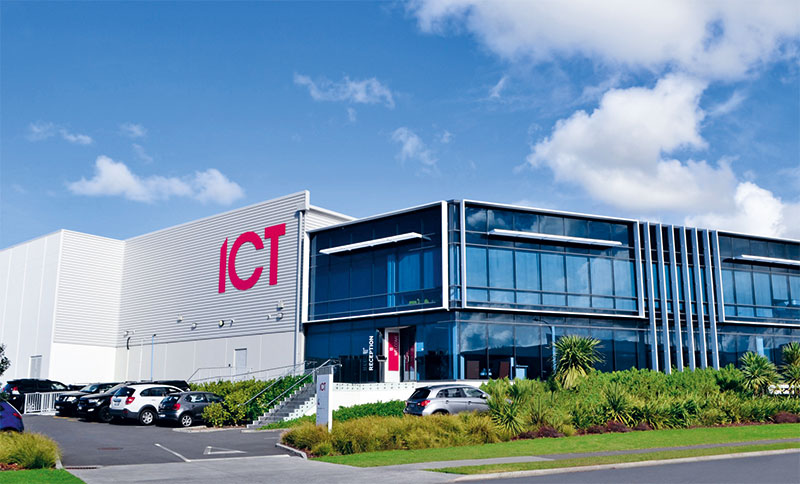
The New Zealand-based company Integrated Control Technology (ICT) was founded in 2003 by Hayden Burr and his wife, Rachael Burr.
– There was a lot of flying. One year I was out of the country for eight months, constantly travelling. I was on a plane every other week, with young children at home and everything. It was tough, but it had to be done, says Hayden Burr.
Export from the start
At the time of its founding, the family had just moved back to New Zealand after living in Canada. Hayden Burr began developing the Protege platform, a solution combining access control and intrusion alarms. It was launched in 2004 – in Canada.
– I had been away from the security industry here for quite some time, but I still had all my contacts in Canada, he explains.
The time difference, however, required an unusual daily routine.
– It meant calls at three in the morning, support at four, deliveries, invoicing – everything that comes with international trade. But we built the systems, established offices, and worked very purposefully, says Hayden Burr.
In 2006, Protege began selling in APAC, then expanded into the USA a few years later, and four years ago the company also expanded into Europe.
The flagship product
To this day, Protege remains ICT’s flagship product. The scalable security system is available in two versions – Protege GX and Protege WX.
GX is a server-based solution suited to companies with multiple geographically distributed sites and offers extensive integrations, for example with video, biometric systems, and wireless locks.
WX is a web-based system for single sites, focusing on simple and fast installation – it can be configured in just a few minutes.
Changed role in 2025
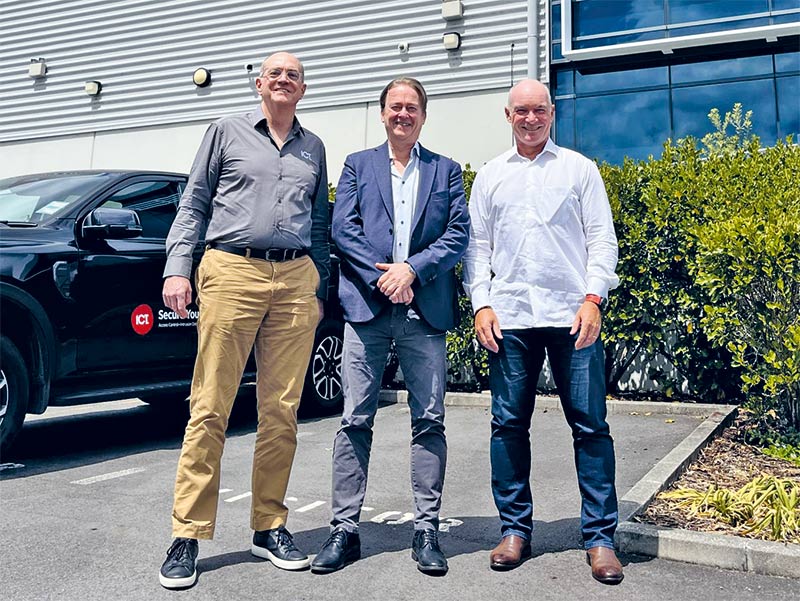
Hayden Burr led the company until early 2025, when the CEO role was handed over to Andy Bane. Burr himself took on the role of Chief Innovation Officer (CINO).
– Don’t get me wrong, I loved being CEO, but I probably enjoy being at the keyboard more, where I can write code and experiment. So it has been a fantastic year, he says.
Andy Bane does not come from the security industry but has primarily worked with startups, served on several boards, and been active in the energy sector. His lack of preconceived notions about the industry was one reason he was well suited to the CEO role.
– We wanted a CEO with the ability to deliver what the business needs and take it to the next level. Andy has done that extremely well, says Hayden Burr.
Commitment remains strong
It is clear that stepping down from CEO to CINO is not about slowing down for Hayden Burr.
– I still do things I probably shouldn’t, and that’s why I don’t sleep at night. I always feel I could have done more.
He also admits that he sometimes gets involved in things he doesn’t need to, but that he has improved at letting go.
– The company is a bit like your baby, and you have to let go for it to grow. Overall, I’ve managed to do that, and it’s been reassuring to have Andy there delivering the right results. So there’s a healthy level of trust.
North America leads
Even though Hayden Burr is no longer CEO, the family-business culture is clearly evident when visiting ICT in Auckland – both in the office and the factory. Everything feels personal and relaxed.
At the same time, the company has grown into a global provider of access control systems, with offices in the USA, Canada, Australia, the United Arab Emirates, the United Kingdom and Hong Kong.
As in the early days, exports dominate sales. North America accounts for 50–55 percent of the business, roughly evenly split between Canada and the USA.
The APAC region (primarily Australia and New Zealand, with some sales in Hong Kong) accounts for approximately 20–30 percent. The same share applies to EMEA. Within EMEA, Hayden Burr sees the Gulf region as a potential growth market, which has led to the establishment of an office in Dubai, United Arab Emirates.
Strong growth in Europe
ICT’s largest markets in Europe are the UK, Iceland, Poland, and the Baltic states.[AD2] [HB3] The company has also seen growth in Norway, Sweden and Finland. Hayden Burr believes that the security situation in Europe has had a positive impact on sales.
– Definitely, Europe has been fantastic for us, and we’ve seen strong growth. The team there has done a very good job. We’ve established offices, technical support, and logistics – all of this drives growth because customers see that we are investing locally.
Mid- to high-security
In its European and Nordic expansion, ICT is focusing on the Protege GX platform and building strong relationships with technology partners and installers.
– Europe is an advanced but complex market with many local requirements. We focus on the mid- to high-security segment and aim to grow in a controlled way without compromising on quality and customer service.
He also emphasises the importance of adapting to local requirements, standards, and expectations.
– We comply with European standards such as CE and EN 50131 and offer training, pre-studies, and design assistance.
Regulations raise the bar
EU regulations such as GDPR, NIS2, and CRA are raising the baseline in the industry, which Hayden Burr sees as positive.
– Cybersecurity is no longer a feature – it’s a requirement. Some players will not be able to keep up and will disappear from the market.
He acknowledges that regulations can slow innovation, particularly for smaller companies, but also sees an advantage: new players can build correctly from the start without technical debt.
– We work with secure storage, encryption, CVE management, and transparency around vulnerabilities. We also use AI to analyse software components.
Both cloud and on-premise
Hayden Burr says there is clear demand for cloud-based access control solutions, which is why the company offers them in certain regions.
– But we don’t want to lock customers into a specific model. We offer on-premise, cloud, SaaS, and hybrid solutions. Otherwise, you’re just selling what you have – not what the customer needs.
According to him, the shift to the cloud is primarily about avoiding the maintenance of in-house infrastructure – updates, cybersecurity, and operating systems.
– It becomes simpler, especially for smaller companies. But we see demand from both small and large organisations.
Several growth drivers
Hayden Burr highlights interoperability as a key factor and says ICT’s philosophy is built on openness. Protege GX offers open APIs and broad integration capabilities with third-party systems such as VMS, elevators, and biometric solutions.
He sees digitalisation, mobile solutions, unified systems, and recurring revenue as the most important growth drivers in access control.
– Many see security as keeping intruders out. But from an operational perspective, it’s about enabling a smooth flow of employees and visitors through the building.
He also points to applications beyond security, such as automated billing via access control and analysis of how facilities are used.
– When it comes to sustainability, systems can automatically control lighting, ventilation, and energy consumption.
Distance – not a problem
Being based in New Zealand – far from many markets – is both an advantage and a challenge.
– New Zealand is a globally trusted country, which has significant value. It is a neutral jurisdiction, and that’s important today. The downside is, of course, the distance, but we’re used to it and leverage it.
However, he does not see ICT as merely a New Zealand company.
– We are a truly global organisation. Our headquarters may be in New Zealand, but we are interconnected through an agile network of local presence. That allows us to meet markets with local understanding and expertise – and that is crucial.



 Global