



Frank Stier is VP & Head of PU Key-based Digital Cylinders at Assa Abloy Opening Solutions EMEIA. The first question to ask him is obvious.
What is the problem with relying primarily on mechanical security?
“Fundamentally, manual mechanical locking was not designed for the complexity of our ‘new normal’. Facilities managers face a challenging environment when it comes to keeping buildings secure, compliant and operational.”
Why is digital locking a better alternative?
“With increased service contracting, many essential functions are now operated by third-party providers, for example. These teams, too, need efficient building access. Ever more sophisticated physical, cyber and ‘hybrid’ physical-cyber threats are emerging, alongside regulations designed to protect against them. Compliance is a moving target. Static legacy systems may struggle in this dynamic environment.”
How can smart keys address these challenges?
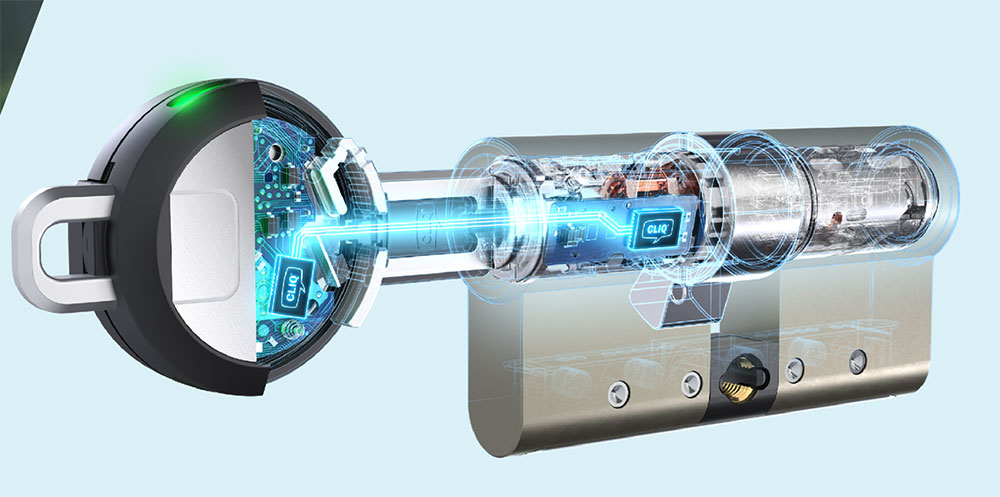
“One huge benefit of the mechanical key is its familiarity. So, in some cases, a mechanical locking system with patent protection may still be appropriate. However, digitalisation offers many opportunities for efficiency and compliance.”
Can you give some examples?
“A digital credential can be programmed or deauthorised in seconds, eliminating the security risks and costs associated with lost mechanical keys. When building technology connects digital solutions for access, fire protection and escape routes, user safety and facilities management benefit. Audit capability is automated, supporting compliance, whereas manual access tracking with mechanical keys is either time-consuming or impossible.”
How can businesses streamline the transition to digital locking?
“Of course, moving from mechanical to digital access is not like flicking a switch. Many organisations cannot change everything at once, so digital systems must scale gradually as budgets allow. This is the main advantage of choosing the right programmable smart key system. It offers the smoothest transition from mechanical to digital access management.”
What are the cost implications?
“Customers are often surprised at how favourably it compares with all realistic alternatives. Smart key systems have the advantage of being the fastest, least disruptive way to switch from mechanical to digital access. Electronic or electromechanical locking cylinders may simply slot into place of legacy devices, without door damage or wiring. Facility management teams gain granular control at a relatively low cost.”
Can you quantify the potential savings?
“Indeed, our smart key white paper models hypothetical costs for a 100-door installation of our Cliq solution. Compared with mechanical locking, Cliq’s total cost of ownership (TCO) over a five-year period was around 64 percent lower, including purchase and installation costs.”
What are the main security benefits?
“The most important are authentication and auditing. With a smart key system, simply possessing a key is of limited benefit. Digital authentication determines whether the keyholder is permitted access, rather than relying solely on mechanical coding. Keys may be set to require periodic revalidation: without regular visits to an updater, or updating via Bluetooth, a key won’t unlock anything.”
Are there other security advantages?
“Unlike a mechanical key, a smart key controls not only who can go where, but also when – and these permissions are not set in stone. Automated logging of every access interaction speeds up investigations if unauthorised use does occur. With their authentication and security features, Cliq smart keys are also effectively impossible to duplicate.”
Which organisations are adopting smart keys?
“In many different environments, customers find the answer to their challenges in a Cliq solution. This diversity of applications is testament to its flexibility and security. For example, Protec2 electromechanical Cliq is trusted in sensitive environments such as medicine stores at Birmingham’s Queen Elizabeth Hospital.”
Can you give more examples of installations?
“Low-impact installation makes Cliq ideal for retrofitting heritage properties, as demonstrated at Munich’s Hofbräuhaus and Dresden’s Frauenkirche. At Düsseldorf’s football stadium, eCliq – a fully electronic smart key system – makes it easy to issue temporary authorisations for contractors and event providers. Wherever deployed, smart keys deliver a tangible return on investment as our white paper explores in greater depth.”
Further reading: Download the white paper.




 Global