



Perimeter Protection and Alarms – Why More People Are Talking About Perimeter Security
Perimeter protection has become a common topic of discussion among security managers, property owners and within the industrial sector. As crime patterns change and security requirements increase, more organisations need to consider how best to protect their premises effectively. In this article, we look at what perimeter protection involves, the solutions available and why it has become such an important issue.
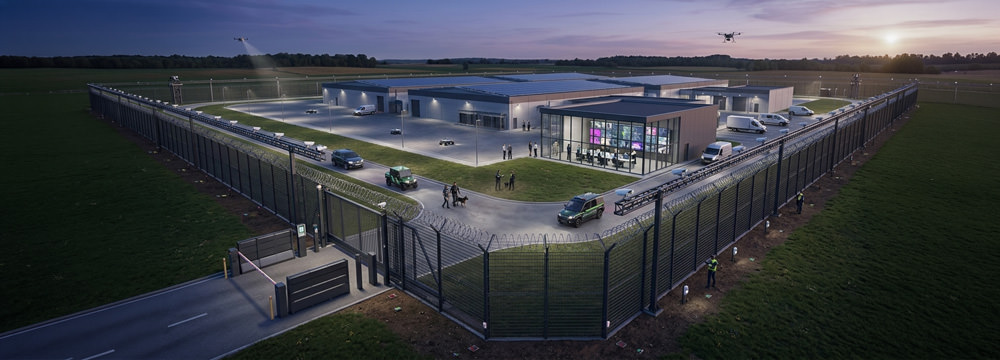
What Is Perimeter Protection and Building Envelope Security?
Perimeter protection involves creating a security zone around an area or property, often using fences, railings or walls in combination with technical solutions and alarm systems. The aim is to detect, delay and deter intrusions before an individual or vehicle reaches the building itself or its inner security zone.
The term building envelope security is sometimes used in a similar context, but more specifically refers to protecting the outer shell of a building – including walls, doors, windows and roofs. Perimeter protection covers the entire area surrounding a building, whereas building envelope security represents the final barrier against intrusion.
By combining different layers of protection (defence in depth), organisations can achieve a stronger security posture, providing early warning and making it more difficult for unauthorised individuals to gain access.
Physical Barriers – Fences, Walls and Gates
The most common way to establish perimeter protection is through the use of physical barriers. These typically include security fencing, railings, walls, gates and entrance barriers. Depending on the threat level and requirements set by authorities or insurance companies, these are often combined with barbed wire, anti-ram protection and other reinforcements.
Examples of physical security measures:
- Security fencing and railings: Available in various security classifications and designs. The Swedish Armed Forces' handbook specifies requirements for height, mesh size and reinforcements. The area immediately surrounding the fence should often be kept clear of bushes and objects that could conceal an intrusion or make climbing easier.
- Barbed wire and razor wire: Often installed along the top of fences to make climbing over them more difficult.
- Vehicle access protection: Gates and entrance barriers can be reinforced with anti-ram measures to prevent vehicles from forcing their way through. At particularly sensitive facilities, automatic bollards or heavy-duty barriers are sometimes used.
- Walls and barriers: Used where more robust protection is required or where appearance is an important consideration. Walls can be supplemented with fencing or technical sensors for additional security.
Physical barriers form the foundation of perimeter protection, but their effectiveness increases significantly when combined with technology and clearly defined procedures.
Technical Solutions – Cameras, Alarms and Sensors
Technical solutions make it possible to detect, verify and respond to attempted intrusions quickly. Today, a wide range of technologies can be integrated into perimeter protection systems:
- Video surveillance (CCTV): Security cameras provide visual monitoring of the area. They can be motion-activated and connected to an alarm receiving centre or mobile device.
- Motion detectors: Detect movement within or close to the protected perimeter. Both passive (infrared) and active (for example, radar-based) versions are available.
- Ground-based sensors: Can be installed in the ground near fences or access routes to detect vibrations, pressure or footsteps.
- Infrared barriers: Invisible beams create a detection line along the fence. If someone crosses the beams, the signal is interrupted and an alarm is triggered.
- Laser systems and radar: More advanced solutions that cover larger areas and can distinguish between people, animals and vehicles.
- Alarm receiving centres and integrated systems: Alarms from sensors and cameras can be connected to an alarm receiving centre, which can respond immediately when an intrusion is detected, for example by dispatching security personnel or alerting the police.
Technical systems provide early warning, record incidents and make it easier to determine whether an alarm is genuine or false.
Organisational and Additional Security Measures
Effective perimeter protection is about more than just fences and alarm systems. Organisational measures also play an important role in improving security:
- Security lighting: Lighting along fences, gates and entrances reduces the risk of intrusion, particularly at night.
- Vegetation management: The area immediately surrounding the fence should be kept clear of bushes, trees and objects that could provide cover or be used to climb over the fence.
- Security guards and patrols: On-site security personnel and regular patrols can act as a deterrent and ensure a rapid response to suspicious activity.
- Access control procedures: Clear procedures and technical solutions should be in place to register and check everyone entering or leaving the premises. These may include keypads, access cards or digital visitor registers.
Combining physical, technical and organisational measures provides significantly better protection than relying on individual solutions alone.
Balancing Different Security Measures
There is no one-size-fits-all solution for perimeter protection. The most effective security comes from combining physical barriers, technical surveillance and well-established procedures. This approach is often referred to as defence in depth, where each layer helps to delay, deter or make an intrusion more difficult.
A high fence on its own provides a certain level of protection, but remains vulnerable without alarms or cameras. Modern perimeter protection therefore relies on different layers of security working together – from gates and fences to technology and trained personnel.
Why Is Interest in Perimeter Protection Increasing?
There are several reasons why perimeter security and site protection are attracting more attention today:
- Crime trends: The number of break-ins, thefts and acts of sabotage has increased, particularly targeting industrial facilities, warehouses and critical infrastructure.
- Threats to essential services: Power and water utilities, telecommunications, transport networks and other essential services face increasingly stringent security requirements.
- Lower technology costs: The cost of advanced video surveillance, alarm systems and sensors has fallen, making technical security solutions more accessible to a wider range of organisations.
- The need for early warning: The earlier an intrusion is detected, the greater the chance of preventing damage or criminal activity.
- Insurance requirements and regulatory standards: Insurance companies and public authorities often require certain security measures to be in place for an organisation or facility to meet the necessary requirements.
Businesses and organisations increasingly view perimeter protection as an investment in safer operations and reduced risk.
Summary
Perimeter protection involves securing and defining the boundaries of an area using fences, gates, technical systems and clearly established procedures. A wide range of solutions is available, from simple fencing to advanced alarm systems, cameras and sensors. The greatest level of protection is achieved when different security layers are combined and work together.
Before selecting the right solutions, it is important to carry out a thorough risk assessment. Consider the threat landscape, the specific requirements of the organisation and the possibilities for combining physical security, technology and procedures. By investing in a balanced perimeter protection strategy, you can strengthen protection against intrusions and create a safer environment for both the organisation and its staff.







 Global