



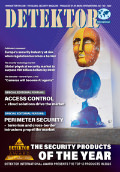

The Detektor International Award (DI Award) ceremony will take place on October 20th during Skydd – the largest security trade fair in the Nordic region – at the Stockholm International Fairs in Sweden. During the ceremony, the manufacturer that will be awarded the first prize – Best Product Award – and the two that will receive the Innovative Achievement Award will be revealed.
International Industry Award
Since 2000, the Detektor International Award has recognised security products and solutions that stand out through innovation, new thinking and clear customer benefit. The award was established by the trade magazine Detektor International to encourage technical development and reward solutions that contribute to the continued development of the security industry.
An important basis for the Detektor International Award is its independence. Manufacturers cannot apply to have their products nominated. Instead, the candidates are selected by Detektor's editorial team based on ongoing international news coverage and the editorial team's presence at leading security trade fairs around the world. The selection includes products and solutions that have been launched on the international market during the last twelve-month period.
"It is not too rare that the 12 products nominated also reflect the major technology trends in the security market," says Detektor's editor-in-chief Lennart Alexandrie, who believes that 2026 is no exception.
"Cloud solutions are of course included, as is the AI trend, especially the development towards the use of generative AI to use natural language to talk about what you want need from the security systems, perform searches, create reports and request the data you want," he says.
Four categories
The Detektor International Award is presented in four categories: Alarm & Detection, ID & Access Control, Video Surveillance and IoT & Security Solutions. Three products or solutions are nominated in each category, which means a total of twelve finalists. The final winners are decided by Detektor's international jury, which is connected to the magazine's editorial staff. The first prize winner in each category is awarded the Best Product Award and receives the unique glass sculpture, designed by Bertil Vallien. The other nominees are awarded the Innovative Achievement Award.
Previously we have presented the nominees in ID & Access Control and Alarm & Detection. Today we present the nominees in the Video surveillance category:
Company: Genetec (Canada)
Product: Security Center SaaS
Genetec Security Center SaaS is a cloud-based platform for physical security that brings together video surveillance and access control in a common system. The platform's new AI-based investigation functions enable operators to quickly search and track people, vehicles and events across multiple cameras and data sources. With Natural language search, the user can describe what is being searched for in plain language, while functions such as Similar people, Nearby activity and Visual trajectory help reconstruct the course of events. The aim is to reduce complex investigations from hours to minutes.
Company: Iqsight (Netherlands)
Product/Solution: IVA Pro Context
IVA Pro Context, is an AI-based video analytics solution that combines traditional Intelligent Video Analytics with generative AI and Large Vision Models (LVM). The solution can not only identify people, vehicles and objects but also interpret activities and context in a scene and describe events using natural language. The operator can use natural language to search and analyse video material with captioned questions, which simplifies and speeds up investigations. IVA Pro Context combines edge-based video analytics with advanced AI processing that can be done locally or via the cloud, depending on the implementation and security requirements.
Company: Openeye (USA)
Product/Solution: AI Visual Check
AI Visual Check is an AI-based feature in Openeye Web Services (OWS) that automates visual checks using existing surveillance cameras. The user can use natural language to describe what the system should check, for example if an emergency exit is blocked, a door is open or an object is missing. The AI analyses camera images based on the instructions and can alert the operator to deviations. In this way, recurring manual inspections can be automated and the cameras can be used for both security and operational and process control.












 Global