





Market performance in 2025 revealed significant regional contrasts. North America and Western Europe delivered strong growth, propelled by AI-enabled system upgrades, accelerated replacement cycles, and stringent compliance mandates, including the US National Defense Authorization Act (NDAA) and the EU AI Act. Emerging markets also expanded strongly, supported by large-scale government infrastructure investments and rapid urban development.
China was a notable exception, with the market declining 2.0% in 2025. Macroeconomic pressures, anti-involution policy initiatives, and constrained public-sector budgets contributed to the market’s fourth consecutive annual decline.
Hardware inflation to propel double-digit growth in 2026
Omdia forecasts that market growth will accelerate to 12.8% in 2026—driven primarily by component price escalation rather than volume increases. The rapid expansion of hyperscale AI data centres has triggered intense competition across industries for memory chips, storage devices, and semiconductor manufacturing capacity. This supply-demand imbalance is extending procurement lead times and driving significant price inflation for critical hardware components.
Three strategic shifts are reshaping the global video surveillance market
1. Software captures a growing share of market value
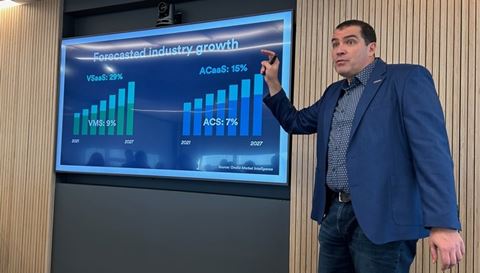
Software is accounting for an increasing share of total market value as customers shift towards outcome-driven solutions. Monetisation of AI-powered analytics, wider adoption of Video Surveillance as a Service (VSaaS), and growing enterprise preference for operational outcomes over capital equipment are driving software penetration upward. This trend is particularly evident across government and industrial applications and in developed markets.
2. Cyber security and data sovereignty regulations converge
Global regulatory frameworks are moving beyond traditional product safety standards to include mandatory cyber security protocols and data localisation requirements. India's market contracted 9.4% in 2025 following the enforcement of Standardization Testing and Quality Certification (STQC) requirements, demonstrating how compliance barriers can significantly affect market performance.
As additional regulations, including Vietnam's QCVN 11:2026 technical standards and the EU's Cyber Resilience Act (CRA) become operational, manufacturers face growing pressure to integrate security-by-design principles throughout product development cycles or risk being excluded from market and left with inventory that can no longer be sold.
3. China shifts from volume to value creation
Following years of market contraction, China's video surveillance market is beginning to stabilise as manufacturers adjust their strategies. Leading manufacturers have moved away from prioritising market share and are placing greater emphasis on profitability. This includes withdrawing from low-margin segments, reallocating capital toward differentiated AI capabilities, and implementing stricter project selection criteria focused on cash flow and receivables management.
“With component inflation expected to continue through 2027, organisations should reassess their storage infrastructure strategies, prioritise vendor-agnostic video management platforms, and explore hybrid cloud architectures. These measures help strengthen supply chain resilience and manage total cost of ownership in an increasingly constrained hardware environment,” said Senior Principal Analyst, Tommy Zhu.










 Global