



These numbers, according to Alcatraz, reveal a hard truth: while companies continue to pour resources into cyber security, a single compromised badge or tailgating incident at the door can open the same pathways to devastating consequences.
In today’s environment of escalating threats, regulatory pressure, and hybrid work dynamics, the traditional approach of granting trust once someone is “inside” no longer holds. This is why enterprises across industries are adopting Zero Trust security models, and why multi-factor authentication (MFA) for physical access has become essential.
What zero trust means in physical security
Zero Trust has been widely adopted in IT, but its core principle—never trust, always verify—applies just as urgently to physical spaces. In the built environment, Zero Trust means that every attempt to enter a door, secure area, or facility must be validated in real time. It means that a badge alone is no longer enough, because badges can be cloned, stolen, or shared. It also means that authentication cannot stop at the perimeter but must continue at sensitive zones inside a building, where the stakes are often highest.
Why MFA is essential
Multi-factor authentication strengthens access control by requiring more than one form of proof before entry is granted. Traditionally this means combining something you have, like a badge, with something you know, like a PIN, or something you are, like a biometric identifier. By layering these methods, MFA makes it exponentially more difficult for unauthorised individuals to slip through.
For organisations pursuing zero trust, MFA isn’t optional. It is the mechanism that prevents insider threats, neutralises lost or stolen credentials, and assures compliance with increasingly strict regulatory frameworks. The challenge, however, has always been balancing security with convenience. Too often, MFA in the physical world has meant friction—slowing down employees, frustrating end users, and creating operational bottlenecks.
Alcatraz Rock X - a game changer
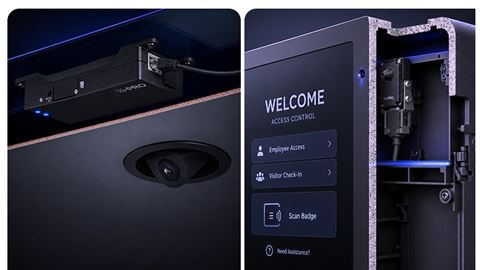
According to the company, the Rock X can change the game. Unlike many traditional MFA solutions that require complicated integrations or costly system replacements, Rock X installs directly in-line with existing access control systems using Wiegand or OSDP. There is no rip-and-replace required. With Rock X, enterprises can instantly add a seamless biometric layer to their current infrastructure.
What sets Rock X apart, argues Alcatraz, is its ability to verify identity at walking speed through facial authentication. Instead of fumbling with multiple credentials, employees can simply present their badge or PIN, while Rock X simultaneously and instantly validates their identity with advanced biometric verification. The result is MFA that is both effortless and uncompromising.
Rock X makes it simple to implement different MFA models depending on the level of security required.
- Two-Factor Authentication (2FA) combines facial authentication with another credential. For example, Rock X can require both a badge swipe and a face match before granting access. This prevents a lost or cloned badge from being misused, since the biometric confirmation ensures the credential belongs to the right person.
- Three-Factor Authentication (3FA) is used in the most sensitive environments. In this scenario, Rock X can be paired with both a badge reader and a PIN code reader, requiring all three credentials—badge, PIN, and face—for entry. This layered approach makes unauthorized access virtually impossible and is especially valuable in data centres, research labs, and government facilities.
With both 2FA and 3FA options, Rock X promises the flexibility to meet the security demands of any organisation without sacrificing ease of use.
Adaptive MFA
Not every user or scenario requires the same level of access control. Executives or VIPs, for example, may need streamlined entry experiences, while employees working in high-security areas must face stricter requirements. Rock X supports this reality by enabling adaptive MFA. Organisations can enforce MFA everywhere it is required, while offering face-only access to trusted groups where appropriate. The system also allows biometric opt-in and opt-out to align with privacy preferences, and device-based intelligence adds another layer of context for higher assurance.
This flexibility means MFA no longer feels like a one-size-fits-all barrier. Instead, it adapts to business needs, regulatory mandates, and individual risk profiles, making zero trust practical without adding unnecessary friction.
According to Alcatraz, the demand for MFA is growing fastest in industries where the stakes are highest and compliance is most strict:
Data centres: Protect customer data and ensure uptime with layered security at every door.
Critical infrastructure: Defend against insider and outsider threats across utilities, manufacturing, and energy facilities.
Financial institutions: Safeguard vaults, branches, and data centers against credential misuse.
Healthcare and pharma: Protect sensitive labs, storage areas, and patient data while meeting HIPAA and other regulatory standards.
Corporate campuses: Balance security and convenience across thousands of employees and multiple access points.
Zero Trust has made its mark in IT. Now, it is redefining physical security. Alcatraz asserts the solution at the core of this transformation is MFA.



 Global